The inherent power to vacate CPLR 5015

Katz v Marra, 2010 NY Slip Op 04957 (App. Div., 2nd 2010)

Pursuant to CPLR 5015(a), "[t]he court which rendered a judgment or
order may relieve a party from it upon such terms as may be just." This
statute sets forth certain grounds for vacatur, including excusable
default, newly-discovered evidence, fraud, misrepresentation, and lack
of jurisdiction. As recognized by the Court of Appeals, the drafters of
CPLR 5015 did not envision that this statute would provide an exhaustive
list of the grounds for vacatur (see Woodson v Mendon Leasing Corp.,
100 NY2d 62, 68). Instead, a court retains "its discretionary power
to vacate its own judgment for sufficient reason and in the interests
of substantial justice'" (Goldman v Cotter, 10 AD3d 289, 293, quoting Woodson
v Mendon Leasing Corp.,
100 NY2d at 68; see Ladd v Stevenson, 112
NY 325, 332). However, "[a] court's inherent power to exercise control
over its judgment is not plenary, and should be resorted to only to
relieve a party from judgments taken through [fraud,] mistake,
inadvertence, surprise or excusable neglect"
(Matter of McKenna v
County of Nassau Off. of County Attorney,
61 NY2d 739, 742 [internal
quotation marks omitted]; see Long Is. Light Co. v Century Indem. Co., 52
AD3d 383
, 384; Quinn v Guerra, 26 AD3d 872, 873).

***

Here, the defendant failed to establish grounds warranting relief under
CPLR 5015(a)(1)

***

In our view, this case does not warrant the invocation of a court's
inherent power to vacate its orders and judgment in the interest of
substantial justice. Notwithstanding the dissent's characterization,
there is nothing unique or unusual about this case. This Court has
previously found that claims of financial distress are not sufficient to
justify the exercise of the court's inherent discretionary power to
vacate its own judgment in the interests of substantial justice
(see Matter of Dayton Towers Corp. v Gethers, 24
AD3d 663
, 664). Simply stated, this is not an appropriate case in
which to exercise the broad equity power of a court to vacate its own
orders and judgment.
We note that the cases cited by the dissent for the proposition
that vacatur is warranted in the interest of substantial justice are
inapposite and/or distinguishable. For instance, in Ruben v American
and Foreign Ins. Co.
(185 AD2d 63), the court vacated a judgment,
upon the "joint" motion and consent of the parties. Other cases relied
upon by the dissent, such as Government Empls. Ins. Co. v Employment
Commercial Union Ins. Co.
(62 AD2d 123) and Soggs v Crocco (247
AD2d 887), did not involve a motion to vacate an order or judgment
entered upon default.

In May of 2009, I posted a case where the Appellate Division, Third Department, found facts sufficient to warrant vacatur in the interest of justice: Kostun
v Gower
61 AD3d 1307 (App. Div., 3rd, 2009).  That case was also interesting because of FN 1.  In June of 2009, I posted a Appellate Division, First Department, case, where the court found sufficient facts: Diane
v Ricale Taxi, Inc.
,
2009 NY Slip Op 05680 (App. Div.,
1st, 2009).

Looks like I picked the wrong week to quit sniffing glue

It’s time for my tri-weekly post of roundups of writing posts, motivational posts, and other assorted things that have piqued my interested.  Most everything is something I found through my RSS reader.

Writing

Motivation

Everything else

A little while ago I shared my fascination with books.  Today I found a post on Japanese pens.  Yes, I spent the time to read a post on Japanese pens and then took the time to write about me reading a post on Japanese pens.

The rest of it

I read a lot blogs.  Some I read for the content.  Others I read because I like the way the writers write.  I don’t know why, but from my experience, the best writers are criminal defense attorneys.  Two of the best are Norm Pattis (Norm Pattis blog) and Scott Greenfield (Simple Justice).  For pure writing skill and style, they are way at the top.  I read the blogs for the content too, but that’s not the point here.  And I’m not talking about good writing as in grammar.  Anyone with a handbook can do that.  I’m talking about engaging prose.  Stuff you actually want to read.  Both have different styles.  Both are worth reading, and in my opinion, worth emulating.  Is there something about criminal defense that lends itself to good writing, more so than civil litigation?

So you want to pull the file

Occasionally I see a decision and want to read the briefs or underlying papers.  if it's recent enough, the Appellate Division (the vast majority of the cases I post are Appellate Division cases) might still have the file.  The Second Department sends everything back to the lower court when they are done with it; not sure about everyone else.

So, let's assume that you want to pull the briefs.  First, you'll need either the index number of the Appellate Division number.  Sometimes both will be on the decision.  Sometimes neither.  Usually, at the very least it will have the Appellate Division number.

Let's start with a decision: Miller
v Bah
,
2010 NY Slip Op 04753 (App. Div., 2nd, 2010)

If you have the Appellate Division number, you can go to the Appellate Division and see if the file is there.  If the file was send back to the lower court, you can take the index number and pull the file with that.  If you don't have either, the Appellate Division can probably get it for you if you tell them the caption.  
Miller v Bah (2010 NY Slip Op 04753)-1

If all you have is the caption, and you don't want to talk to the Appellate Division, you can head over to elaw or ecourts.  I'm going to use ecourts for an example.   Head over there and click on Webcivil Supreme (the lower court was the supreme court).

Then click party search.
WebCivil Supreme

Now put in the name of one of the parties, or both.  I used both.  Initially I tried using one of the names, but the search results sucked.  I put Nassau County because that's where the case came from.


ECourts

WebCivil Supreme - Case Search And the results.

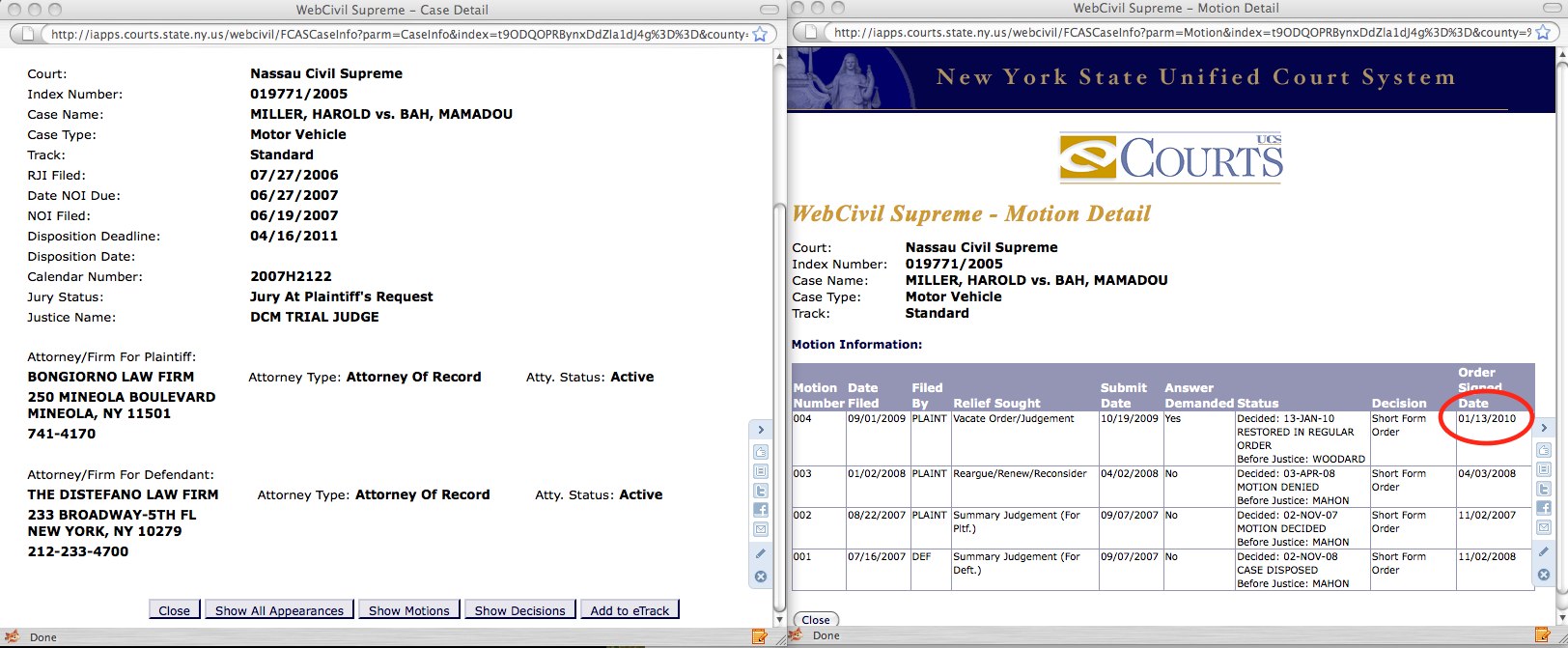
WebCivil Supreme - Case Search Results-1If you click on the index number, you get the box on the left.  If you click "show motions" on the box on the left, you get the box on the right.  Aside from the parties matching up, notice that the date with the circle (on the left) corresponds with the date of the order in the decision.  It looks like we have the right case.

WebCivil Supreme - Case Detail

Now you have enough information to walk into the lower court and pull the papers. 

Using e-law is much easier, but you have to register.

It might be easier just to call the court.  But if you don't want to do that, and don't feel like registering for elaw, you can do this.

Admissions by omission CPLR § 3018(a)

CPLR
§
3018 Responsive pleadings
(a) Denials

Miller v Bah, 2010 NY Slip Op 04753 (App. Div., 2nd, 2010)

After first considering the evidence presented by the plaintiff, the
Supreme Court next considered certain admissions made by the defendant.
In this regard, the complaint contained certain allegations concerning
the defendant's ownership and operation of a particular vehicle at the
time of the accident, which the defendant failed to address in his
answer. The defendant therefore was deemed to have admitted the truth of
those allegations
(see CPLR 3018[a]; Maplewood, Inc. v Wood, 21
AD3d 933), and "admissions . . . in pleadings are always in evidence
for all the purposes of the trial of [an] action"
(Braun v Ahmed, 127
AD2d 418, 422 [internal quotation marks omitted]). The Supreme Court
found that even when the evidence was coupled with the defendant's
admissions, the plaintiff failed to "link" the defendant to the
offending vehicle. Thus, the Supreme Court granted the defendant's
motion pursuant to CPLR 4401 for judgment as a matter of law.

Appearance by Service CPLR R. 320

CPLR R. 320 Defendant's appearance

Goonan v New York City Tr. Auth., 2010 NY Slip Op 04742 (App. Div., 2nd, 2010)

A plaintiff may seek leave to enter a default judgment when a defendant,
among other things, has failed to appear within the time required (see
CPLR 3215[a]; Okeke v Ewool, 66 AD3d 978, 979). A defendant
appears, inter alia, by serving an answer upon the plaintiff (see
CPLR 320[a]; Cerrito v Galioto, 216 AD2d 265, 266; cf. Ahmad v
Aniolowiski
, 28 AD3d 692, 693). Contrary to the plaintiff's
contention, there is no statutory or other requirement that an answer,
timely served upon a plaintiff, must also be filed with the clerk of the
relevant court in order for a defendant to appear in the action. Here,
the defendant appeared in the action by timely serving its answer upon
the plaintiff (see CPLR 320[a]; Siegel, NY Prac § 110, at 199
[4th ed]) and, therefore, there was no default.

CPLR R. 3212(f) Hope and Speculation not Enough

CPLR R. 3212
Motion for summary judgment

(f)
Facts unavailable to opposing party

Essex Ins. Co. v Michael Cunningham Carpentry, 2010 NY Slip Op 04732 (App. Div., 2nd, 2010)

Andreassen's contention that the motion for summary judgment was
premature is without merit. It failed to offer any evidentiary basis to
suggest that discovery may lead to relevant evidence. The hope and
speculation that evidence sufficient to defeat the motion might be
uncovered during discovery was an insufficient basis to deny the motion (see Peerless Ins. Co. v Micro Fibertek, Inc., 67
AD3d 978
, 979; Tedesco v Tedesco, 64 AD3d 583, 584; Conte v Frelen Assoc., LLC, 51 AD3d 620,
621).

There are plenty of cases on this issue, but I like the brevity of this one.

Just after I read this one, I found another.

Family-Friendly Media, Inc. v Recorder Tel. Network, 2010 NY Slip Op 04735 (App. Div., 2nd, 2010)

CPLR 3212(f) permits a party opposing summary judgment to obtain further
discovery when it appears that facts supporting the position of the
opposing party exist but cannot be stated (see Aurora Loan Servs.,
LLC v LaMattina & Assoc., Inc.,
59 AD3d 578; Juseinoski v New
York Hosp. Med. Ctr. of Queens,
29 AD3d 636, 637). Under the
circumstances of this case, the Supreme Court properly denied that
branch of the plaintiff's motion which was for summary judgment on the
complaint as premature, without prejudice to renew
(see Matter of
Fasciglione,
AD3d, 2010 NY Slip Op 03926 [2d Dept 2010]; Baron v
Incorporated Vil. of Freeport,
143 AD2d [*2]792,
792-793).

And one from the First Department.

Montalvo v Chiaramonte, 2010 NY Slip Op 04707 (App. Div., 1st, 2010)

Neither plaintiffs nor Chiaramonte submitted any affidavits or evidence
to show that "facts essential to justify opposition [to the Tarts'
motion] may exist but cannot then be stated" (CPLR 3212[f]). Nor did
they ever challenge the motion court's finding that the "Tart vehicle
never came into contact with the decedent."

Waiver and Amendment CPLR R. 3211(e); CPLR R. 3025(b)

CPLR R. 3025 Amended and supplemental
pleadings
(b) Amendments and
supplemental pleadings by leave

CPLR R. 3211 Motion to dismiss
(e)
Number,
time and waiver of objections; motion to plead over

Complete Mgt., Inc. v Rubenstein, 2010 NY Slip Op 04726 (App. Div., 2nd, 2010)

However, the Supreme Court improvidently exercised its discretion in
denying that branch of the defendants' motion which was for leave to
amend their answer to assert the affirmative defense of lack of capacity
to sue. Although the defendants waived this defense by failing to raise
it in their answer or in a motion to dismiss made prior to answering (see
CPLR 3211[a]
[3];[e]; FBB Asset Mgrs. v Freund, 2 AD3d 573, 574; Harte
v Richmond County Sav. Bank,
224 AD2d 585, 586), " defenses waived
under CPLR 3211(e) can nevertheless be interposed in an answer amended
by leave of court pursuant to CPLR 3025(b) so long as the amendment does
not cause the other party prejudice or surprise resulting directly from
the delay'"
(Nunez v Mousouras, 21 AD3d 355, 356, quoting Endicott
Johnson Corp. v Konik Indus.,
249 AD2d 744, 744). Under the
circumstances of this case, the granting of leave to amend would not
have resulted in prejudice or surprise to the plaintiff, and the
proposed amendment was neither palpably insufficient nor totally devoid
of merit (see Bajanov v Grossman, 36 AD3d 572, 573; Nunez
v Mousouras,
21 AD3d at 356).

Compare with

Sackett v Konigsberg, 2010 NY Slip Op 04765 (App. Div., 2nd, 2010)

Contrary to the plaintiff's contention, the Supreme Court properly
granted the defendants' motion to strike the amended complaint based
upon her failure to comply with CPLR 3025. The record indicates that the
plaintiff served her amended complaint well beyond the period within
which an amended pleading may be served as of right (see CPLR
3025[a]) without first obtaining leave of the court or the stipulation
of the parties (see Nikolic v Federation Empl. & Guidance Serv.,
Inc.,
18 AD3d 522, 524).

The appeal from the order dated March 17, 2008, must be dismissed
as abandoned, as the plaintiff does not seek in her brief reversal or
modification of any portion of the order (see Sirma v Beach, 59
AD3d 611, 614; Bibas v Bibas, 58 AD3d 586, 587).

Late Supplemental BP

CPLR R. 3043 Bill of particulars in personal injury actions

(b) Supplemental bill of particulars without leave. A party may serve a supplemental bill of particulars with respect to claims of continuing special damages and disabilities without leave of court at any time, but not less than thirty days prior to trial. Provided however that no new cause of action may be alleged or new injury claimed and that the other party shall upon seven days notice, be entitled to newly exercise any and all rights of discovery but only with respect to such continuing special damages and disabilities.

(c) Discretion of court. Nothing contained in the foregoing shall be deemed to limit the court in denying in a proper case, any one or more of the foregoing particulars, or in a proper case, in granting other, further or different particulars.

Spiegel v Gingrich, 2010 NY Slip Op 04645 (App. Div., 1st, 2010)

The motion court, although it properly concluded that RSD was not a
"new" injury, but a sequela of plaintiff's original injury, granted the
motion to strike the supplemental bill of particulars because it was
served 12 days before trial was scheduled to commence. This alleged
"delay" resulted in the adjournment of the trial without date.

The CPLR contemplates that supplemental bills of particulars may
be served 30 days before trial without leave of court (see CPLR
3043[b]). However, the CPLR grants a motion court the discretion to
determine whether to allow a "late" supplemental bill, or an amended
bill of particulars, provided no prejudice to the defendant results.
Indeed, CPLR 3043[c], entitled "discretion of court," provides,
"[N]othing contained in the foregoing shall be deemed to limit the court
in denying in a proper case, any one or more of the foregoing
particulars, or in a proper case, in granting other, further or
different particulars." 

Defendant herein cannot
seriously contend that he was prejudiced. He argued, before the motion
court, that evidence of RSD was in the record as early as June 2007,
citing Dr. Doolan's assessment. Further, the adjournment of the trial
without a date furnished ample opportunity for defendant to conduct
discovery concerning plaintiff's allegation that she suffers from RSD.
Given the manifest lack of prejudice to defendant, together with the
adjournment of the trial without a date, it was an improvident exercise
of discretion for the motion court to grant the motion to strike
plaintiff's supplemental bill of particulars, based solely on the fact
that the supplemental bill was served 12 days before the scheduled trial
date.

The pretrial order limiting the scope of plaintiff's expert's
expected trial testimony is not appealable before a judgment after trial
is rendered (Santos v Nicolas, 65 AD3d 941 [2009]). Thus,
we dismiss the appeal from this order.

All concur except Tom, J.P. and DeGrasse, J. who dissent
in part in a memorandum by DeGrasse, J. as follows:

DeGRASSE,
J. (dissenting in part)

I respectfully dissent. Plaintiff was injured when she slipped and
fell on defendant's boat. Her supplemental amended bill, served 14 days
before trial, contravened the 30-day deadline set forth in CPLR 3043(b).
She did not seek leave to serve a late supplemental bill, and offered
no reasonable excuse for her delay (see Torres v Educational Alliance,
300 AD2d 469, 470-471 [2002]).

The pretrial order limiting the scope of plaintiff's expert's
expected trial testimony is not appealable before a judgment after trial
is rendered (Santos v Nicolas, 65 AD3d 941 [2009]).
Accordingly, I would affirm the order entered September 28, 2009, which
granted defendant's motion to strike plaintiff's supplemental amended
bill of particulars, and dismiss the appeal from the order entered on
the same date which granted defendant's motion to preclude plaintiff's
biomedical engineer from testifying at trial as to proximate cause.

CPLR § 202 Plaintiff is a resident of its state of incorporation

 CPLR § 202 Cause of action accruing without
the state

Verizon Directories Corp. v Continuum Health Partners, Inc., 2010 NY Slip Op 04640 (App. Div., 1st, 2010)

For purposes of CPLR 202, plaintiff is a "resident" of, and its cause of
action accrued in, Delaware, the state of its incorporation (see
Global Fin. Corp. v Triarc Corp.
, 93 NY2d 525, 529-530 [1999]; American
Lumbermens Mut. Cas. Co. of Ill. v Cochrane
, 129 NYS2d 489 [1954], affd
284 App Div 884 [1954], affd 309 NY 1017 [1956]). We reject
plaintiff's contention that, for purposes of the statute, it is a
"resident" of New York, or that its cause of action accrued in this
State, by virtue of its authorization to do business and asserted
extensive presence here (see Global Fin. Corp., 92 NY2d at
528-29). Hence, New York's six-year statute of limitations does not
apply (see CPLR 202),
and the action is barred by Delaware's one-year statute (10 Del Code
Ann, tit 10, § 8111).

No Subsitute for SJ: CPLR R. 3212(a)

CPLR R. 3212(a)

Brewi-Bijoux v City of New York, 2010 NY Slip Op 04535 (App. Div., 2nd, 2010)

Initially, we note that while the defendants characterized their motion as one for in limine relief to dismiss the complaint for failure to establish a prima facie case, the record reveals that the motion actually was one for summary judgment. "[A] motion in limine is an inappropriate substitute for a motion for summary judgment" (Rondout Elec. v Dover Union Free School Dist., 304 AD2d 808, 810-811; see Rivera v City of New York, 306 AD2d 456, 457). Moreover, the Supreme Court improvidently exercised its discretion in considering this late motion since the defendants failed to offer any excuse for their failure to timely move for summary judgment (see CPLR 3212[a]; Brill v City of New York, 2 NY3d 648; Nobile v Town of Hempstead, 17 AD3d 647; Clermont v Hillsdale Indus., 6 AD3d 376, 377). Such failure warrants denial of the motion without consideration of the merits thereof (see Miceli v State Farm Mut. Auto. Ins. Co., 3 NY3d 725; Brill v City of New York, 306 AD2d 456). Accordingly, we reinstate the complaint.

[Edit 6/4] found another one

West Broadway Funding Assoc. v Friedman, 2010 NY Slip Op 04781 (App. Div., 2nd, 2010)