
I have an unhealthy obsession with books

It's something I just noticed. Not books,
as in novels, stories, etc.  I'm talking about journals, notebooks, and
such.   I have at least 20 moleskins of various size, some of those
marble notebooks that we all used in grammar school, a few generic
moleskins, and other assorted things to write on.  Out of all of them,
I've used maybe 6.  Out of that 6, I got past the first 10 pages on 2 of
them.  

Some I use to take notes.
 Others I use to put quotes.  Then there is the one that I use to put
motivational type stuff in.  And I think there are two with the
same unfinished short story–they are identical, but for the plot.

Notebook  

Even though I
don't use but a handful of them, I want more.  This can't be normal.  Levenger
makes a bunch of cool ones.  I even want to try the Circa line.  Others
are Rhodia

I was going to write more about the
different books, but while I was looking around for links I found a Notebook blog.
 Seriously.

The way I figure it,
anyone who reads this blog is a nerd of sorts.  At the very least, nerdy
enough to read this and be curious enough to take a look at the
notebook blog.

Disclaimer

This blog is published by and reflects the personal views of the blogger, in his individual capacity. It does not necessarily represent the views of his employer or its clients, and is not sponsored or endorsed by them. The purpose of this blog site is to assist in dissemination of information about relevant and irrelevant law , but no representation is made about the accuracy of the information. The information contained in this blog site is provided only as general information for education purposes, and blog topics may or may not be updated subsequent to their initial posting. By using this blog site you understand that this information is not provided in the course of an attorney-client relationship and is not intended to constitute legal advice. This blog site should not be used as a substitute for competent legal advice from a licensed attorney in your state.  Always make sure that any cases discussed or cited remain good law.  Don’t rely on me. I’m not your friend.  Never will be.  I don’t owe you anything.  

I will not do your research for you. etc. etc. etc


Because I have nothing important to say [now with fixed link at the bottom]

and I don't want to post any more decisions today.  The whole reading every decision and posting the interesting one becomes mind-numbing after a while.  My brain is mush as it is.

Every once in a while I check to see how everyone is getting here.  For the most part, you all get here by searching some section or rule.  Many of you are from big firms (good for you).  Others stumble over here from my no-fault blog (really, you want a double dose of my crap?).  And the rest are my devoted readers.  All five of you.  Almost none of you stay more than a couple of minutes.  Many of you, especially the fancy pants biglaw types1, click out of here just as soon as you get here.  This has nothing to do with anything.  I thought some of you might be interested, and if not, I'm glad I able to take a couple of seconds of your life away.

The New York State Bar Association Committee on Civil Practice Law and Rules, for those don't know, is a fun (yes, fun) resource.  You can find recent changes to the rules and case law developments.  That latter is like this blog, but different.  The meeting minutes makes for a good read too.  I spent an hour or so reading them the other night.  Good times.  If you are a member of the committee, please fix the link for the September 11, 2009 minutes.  The link isn't working.  I'm probably the only one who cares about that, but, hey, at least someone cares.

I'm considering putting up a donations thing.  This way you can give me money.  You will get nothing in return.  I won't promise that I will spend the money on one thing or another.  I'm just as likely to spend it on diapers (not for me) as I am to spend it on booze (for me).  It's really just a fantasy.

For those of you who pay attention to what I'm reading, I'm still reading that Gulag book.  I don't know why it is taking me so long to read, but it's a really good book.  Eye opening.

Finally, we have an honest to god SEARCH button now.  It should be much better than the mini google search I've been using.  It's over on the right somewhere.

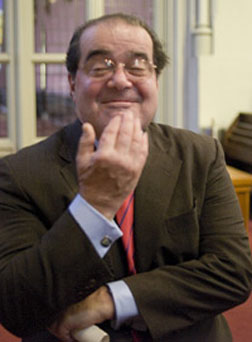
ScalianotamusedOne last thing.  Scalia says hi. 

————–

1.  At least one or two of you people must be a partner, so where's my offer for one of those $200,000.00 a year jobs.  I'm better than worthless (click the link, it will all make sense).

“My Boyfriend’s Back” but my notary is gone

Sirico v F.G.G. Prods., Inc., 2010 NY Slip Op 01733 (App. Div., 1st, 2010)

In May 2008, plaintiffs moved for renewal and reargument,[FN3] contending that the allegations in
Gottehrer's affidavit were conclusory and unsupported by any proof, and
noting that defendant had moved for summary judgment before plaintiffs
had the opportunity to conduct discovery. For those reasons, plaintiffs
argued, they believed their factual allegations in the complaint and
bill of particulars should have withstood the motion for summary
dismissal.

In connection with their motion to renew, plaintiffs submitted
"affidavits" witnessed by out-of-state notaries that were questionable
as to proper form.
Davidson states that she understood from
representations by FGG's owners, including Gottehrer, that FGG would pay
her the same royalties as the Allbuts for recording as a member of the
Angels. According to Davidson, FGG had made one "negligible" royalty
payment to each of the three women. Davidson adds that she never signed
any agreement when joining the group and never signed any waiver or
release of any of her rights, and claims that FGG used her voice, name
and image to sell records. Davidson denied that the Angels ever refused
to record for FGG.

In a similar affidavit, Sirico states that all three women
believed that as a member of the Angels, Davidson was entitled to FGG's
royalties, and in fact FGG gave each of the women one royalty check. She
denies having breached her contract by refusing to perform for FGG, and
states that she recorded for another label only after the exclusivity
period of the contract had expired.

Defendant opposed plaintiffs' motion and cross-moved for
sanctions, contending that renewal should be denied because plaintiffs'
affidavits did not contain any newly discovered evidence that could not
have been submitted previously. Defendant also claimed that the
affidavits were improper because the out-of-state notaries'
acknowledgments did not state that plaintiffs' statements were sworn to
in their presence.

The court held that the motion for reargument was untimely, and
plaintiffs' affidavits in support of the renewal were deficient because
they were unsworn, but in any event were insufficient to defeat
defendant's prima facie showing.
It noted that Davidson did not provide
any details about the terms of her alleged contract with FGG, and held
that plaintiffs had not justified their failure to submit admissible
evidence to oppose the summary judgment motion, concluding that
[*4]

On this record – riddled with procedural mistakes and
deficiencies – there is no reason for the Court to exercise its
discretion and overlook plaintiffs' repeated oversights.

There
is, of course, no appeal from denial of reargument. However, the denial
of renewal is reversed. "Although renewal motions generally should be
based on newly discovered facts that could not be offered on the prior
motion (see CPLR 2221[e]), courts have discretion to relax this
requirement and to grant such a motion in the interest of justice" (Mejia
v Nanni
, 307 AD2d 870, 871 [2003]). While plaintiffs should have
submitted admissible evidence to oppose the summary judgment motion,
their failure is excusable. Defendant moved for summary judgment before
plaintiffs had the opportunity to conduct discovery, and plaintiffs'
counsel reasonably believed that defendant had failed to make a prima
facie showing of entitlement to judgment

***

Contrary to the renewal court's ruling, plaintiffs' affidavits are
admissible.
Each contains the affiant's statement that she was duly
sworn and believes the affidavit's contents to be true and correct, and
the notary's statement that the affiant personally appeared, proved her
identity, and "did further acknowledge that she executed the foregoing
for the purposes therein contained" (see Feldman v Feldman, 280
AD2d 276, 277 [2001]; Collins v AA Truck Renting Corp., 209 AD2d
363 [1994] [notary "is presumed to have acted within his or her
jurisdiction and carried out his or her duties as required by law"]).

The bold is mine.

Shady Grove is out (SCOTUS): CPLR § 901(b) v. FRCP 23

You might recall the Shady Grove case, Shady Grove Orthopedic Associates, P.A. v. Allstate Ins. Co. The issue there was whether a class action to collect overdue interest (a penalty) could be maintained in Federal Court under FRCP 23, when CPLR 901(b) prohibits a class action to “recover a penalty.”  The District Court said no, the 2nd Circuit affirmed.  Now, the Supreme Court reverses.

It was argued not too long ago, and now, we have a decision (5-4) (2010 WL 1222272): It’s fine, the class action can proceed in federal court.

Until I get a chance to go through the decision, you can have a look at my earlier post on the case, or head over to the SCOTUSblog to read an excellent summary of today’s decision.

“the case is already in the gate, so to speak”

Rubin v SMS Taxi Corp., 2010 NY Slip Op 02414 (App. Div., 1st, 2010)

As the motion court found, defendants met their initial burden of
producing evidentiary proof in admissible form sufficient to show that
plaintiff's neck and back injuries did not meet any serious injury
thresholds. Plaintiff's medical submissions were devoid of information
to substantiate his 90/180 claim. The plaintiff also failed to raise an
issue of fact as to any other category from Insurance Law § 5102 because
he did not show: (1) what medical tests were performed, (2) the
objective nature of the tests, (3) what the normal range of motion
should be and (4) the significance of plaintiff's limitations. Plaintiff
thus failed to raise an issue of fact as to the claims for permanent
loss, permanent consequential limitation and significant limitation of
use of a body part, system or function (see Marsh v City of New York, 61 AD3d 552
[2009]; Valentin v Pomilla, 59 AD3d 184, 186 [2009]).
Further, plaintiff's unsworn affirmation is insufficient to explain his
cessation of treatment (see Pommells v Perez, 4 NY3d 566, 574
[2005]).

Plaintiff also failed to offer the requisite competent medical
proof of incapacity during 90 of the first 180 days following the
accident (see Moses v Gelco Corp., 63 AD3d 548 [2009];
Dr. Valderrama's assertion that he advised plaintiff to take off from
work until at least July 10 after [*2]the
June 16 accident does not satisfy this requirement. Plaintiff's claimed
inability to perform his job was also not supported by documentation
from his employer (see Ortiz v Ash Leasing, Inc., 63 AD3d 556
[2009]).

However, the motion court found that plaintiff did meet the
serious injury threshold on his claim for significant disfigurement of a
body part in that the scar on his face "is permanent, discolored and no
treatment can improve it." This portion of the motion court's ruling is
not an issue on appeal. At issue on the motion for clarification or
reconsideration is whether or not plaintiff can still present to the
jury the injuries the court found did not meet the "serious injury"
threshold within the meaning of Insurance Law § 5102(d). "Once a prima
facie case of serious injury has been established and the trier of fact
determines that a serious injury has been sustained, plaintiff is
entitled to recover for all injuries incurred as a result of the
accident" (Obdulio v Fabian, 33 AD3d 418, 419 [1st Dept
2006]; see also Prieston v Massaro, 107 AD2d 742 [2d Dept 1985]; Marte v New York City Transit Auth., 59 AD3d 398,
399 [2d Dept 2009]). Consequently, plaintiff is entitled to present his
claim involving facial scarring to meet the threshold for serious
injury under Insurance Law § 5102(d)(iii) (significant disfigurement).
Once a jury determines that plaintiff has met the threshold for serious
injury, the jury may award damages for all of plaintiff's injuries
causally related to the accident, even those not meeting the serious
injury threshold. Whether plaintiff's back and neck injuries were
causally related to the accident are questions of fact for the jury to
resolve.

The legislative intent of New York's No-Fault law was to
"significantly reduce the number of automobile personal injury cases
litigated in the courts," (Licari v Elliot, 57 NY2d 230, 236
[1982]) and to "weed out frivolous claims and limit recovery to
significant injuries" (Dufel v Green, 84 NY2d [1995]).
Accordingly, once an alleged claim meets at least one of the serious
injury thresholds, the statute's gate keeping function, to reduce
caseloads by limiting what the courts adjudicate, is satisfied. As the
case is already in the gate, so to speak, judicial economy is no longer a
reason to preclude plaintiff from presenting to the jury all injuries
causally related to the accident. This comports with the general
principle that a plaintiff is entitled to recover damages that justly
and fairly compensates him or her for all injuries proximately
caused by the accident.

The court denied the motion for reconsideration or clarification
of the initial order, but because it did address the merits in adhering
to the initial determination, the subsequent order is appealable (see Nawi v Dixon, 59 AD3d 363, 364 [2009]).

The bold is mine.

Expert testimony and qualification

Espinal v Jamaica Hosp. Med. Ctr., 2010 NY Slip Op 01917 (App. Div., 2nd, 2010)

The appellants’ contention that the plaintiff’s expert was unqualified to give an expert opinion because the plaintiff did not provide evidence of his credentials is without merit. The plaintiff’s expert established his qualifications by attaching a curriculum vitae demonstrating that he was a board-certified neurologist (see Winney v County of Saratoga, 8 AD3d 944, 945). In any event, the expert’s alleged lack of experience is a factor which goes to the weight to be given to his opinion, and not to its admissibility (see Texter v Middletown Dialysis Ctr., Inc., 22 AD3d 831; Julien v Physician’s Hosp., 231 AD2d 678, 680; Ariola v Long, 197 AD2d 605). [*2]

Furthermore, the affidavit of the plaintiff’s expert was sufficient to raise a triable issue of fact. “It is well settled that an expert’s opinion must be based on facts in the record personally known to the witness, and that the expert may not assume facts not supported by the evidence in order to reach his or her conclusion” (Erbstein v Savasatit, 274 AD2d 445, 446; see Cassano v Hagstrom, 5 NY2d 643, 646; Plainview Water Dist. v Exxon Mobil Corp., 66 AD3d 754, 755). The expert’s opinion, taken as a whole, must also reflect an acceptable level of certainty in order to be admissible (see Matott v Ward, 48 NY2d 455, 459-460; Erbstein v Savasatit, 274 AD2d at 446). Contrary to the appellants’ contention, the affidavit of the plaintiff’s expert was neither so conclusory or speculative, nor without basis in the record, as to render it inadmissible (see Erbstein v Savasatit, 274 AD2d at 446; see also Dandrea v Hertz, 23 AD3d 332, 333). Rather, “[a]ny purported shortcomings in the affidavit went merely to the weight of the opinion” (Erbstein v Savasatit, 274 AD2d at 446). Since the parties offered conflicting expert opinions as to whether the alleged assault exacerbated the injuries the plaintiff sustained in the accident, a question of credibility arises which requires resolution by a jury (see Colao v St. Vincent’s Med. Ctr., 65 AD3d 660, 661; Dandrea v Hertz, 23 AD3d at 333; Barbuto v Winthrop Univ. Hosp., 305 AD2d 623, 624).

Equitable Estoppel and SOL

Some good old procedural fun here.

CPLR § 5701 Appeals to appellate division from supreme and county courts
(a) Appeals as of right

Evan S. v Joseph R., 2010 NY Slip Op 00831 (App. Div., 2nd, 2010)

The June 24, 2008, order appealed from did not decide the defendant's motion to dismiss, but, instead, held it in abeyance. Accordingly, that order is not appealable as of right (see CPLR 5701[a][2]; Acunto v Stewart Ave. Gardens, LLC, 26 AD3d 305; Housberg v Curtin, 209 AD2d 670, 671; Matter of Fritsch v Westchester County Dept. of Transp., 170 AD2d 602), and we decline to grant leave to appeal, as that order was superseded by the order dated September 10, 2008.

Upon reargument and renewal, the Supreme Court should have granted the defendant's motion pursuant to CPLR 3211(a)(5) to dismiss the complaint as time-barred. The plaintiff sought to recover damages for injuries arising from alleged sexual assaults which purportedly occurred in 1995 when he was 10 years old. Pursuant to the toll for infancy (see CPLR 208), the applicable one-year statute of limitations (see CPLR 215[3]; Krioutchkova v Gaad Realty Corp., 28 AD3d 427, 428; Tserotas v [*2]Greek Orthodox Archdiocese of N. and S. Am., 251 AD2d 323, 324) began to run in 2003, after the plaintiff turned 18. Accordingly, the statute of limitations expired in 2004, and the plaintiff's commencement of this action in 2008 was untimely (see McDonald v McDonald, 193 AD2d 590, 591; Pittelli v Schulman, 128 AD2d 600, 602). Further, the alleged threats made by the defendant at the time of the incidents, and on a subsequent occasion while the parties were in high school, did not rise to the requisite level necessary to equitably estop the defendant from asserting the statute of limitations as a defense to this action brought by the plaintiff approximately five years after he reached the age of majoritysee generally Zumpano v Quinn, 6 NY3d 666, 674-675; Santo B. v Roman Catholic Archdiocese of N.Y., 51 AD3d 956, 957-958; Doe v Holy See [State of Vatican City], 17 AD3d 793, 796; Zoe G. v Frederick F.G., 208 AD2d 675, 675-676; Doe v Roe, 5 Misc 3d 1032A).  (

The bold is mine.  I put the link in for Zumpano.  I'm assuming at least on of you will be curious enough to check it out.  You're on your own for the rest.